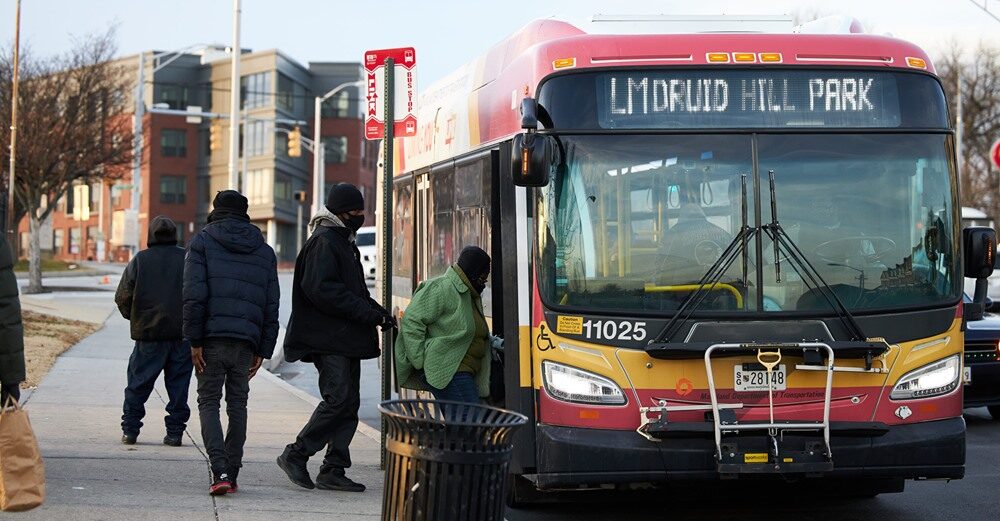
In Maryland, the disparity between spending on road infrastructure and public transit has reached a critical point, particularly under Governor Larry Hogan's administration. Since taking office in 2015, Hogan has directed billions towards highway expansions while the Maryland Transit Administration (MTA) has fallen into significant disrepair.
The MTA, which serves a large number of bus riders, is currently grappling with a staggering $2 billion maintenance backlog and holds the highest breakdown rates for rail systems in the nation, according to a 2019 report from the Federal Transit Administration.
Disproportionately, the transit riders who rely on MTA services are primarily low-income and Black, while the benefits of Maryland's road spending largely favor affluent and white communities. Notably, one in three transit commuters in Baltimore is an essential worker, navigating a transit system that has faced reliability issues throughout the pandemic.
In response to these inequities, a newly formed coalition of environmental, labor, and business leaders is advocating for the Transit Safety and Investment Act, a legislative proposal currently progressing through the Maryland state legislature. This bill seeks to mandate increased annual funding for MTA maintenance and operations over the next five years.
Brooke Lierman, the bill's lead sponsor in the House, emphasizes the need for investment in MTA's assets, stating, "In infrastructure you get what you pay for, and we need to invest the money that it takes to get our assets to a point where they are safe and reliable because they are neither right now."
Local advocates have raised concerns that the lack of preventive maintenance poses safety risks for transit users. Danielle Sweeney from the Central Maryland Transportation Alliance highlighted a past incident where the MTA had to shut down the Baltimore Metro subway for safety reasons with minimal notice to riders.
According to the MTA's 2019 Capital Needs Inventory, an estimated $462 million per year is required for maintenance, plus an additional $100 million for system upgrades. However, recent funding from the Maryland Department of Transportation has fallen short of these needs.
Cory McCray, a sponsor of the bill representing northeast Baltimore, pointed out the severe implications of inadequate public transit on communities, particularly in a city where poverty is prevalent. He stated, "Baltimore residents can’t expect the bus to arrive on time, or to be an acceptable level of cleanliness when it does arrive."
Michael McMillan, president of the Amalgamated Transit Union Local 1300, noted that only 9% of jobs in the region are accessible within an hour via public transit, highlighting the transportation challenges faced by inner-city residents.
The coalition believes that the current administration's focus on road projects has neglected the transit needs of Baltimore, particularly following Hogan's decision to cancel the Red Line, which would have connected underserved neighborhoods across the city.
As the Transit Safety and Investment Act moves forward, advocates hope to rectify the funding imbalance and improve the reliability and safety of Baltimore's public transit system.
Reported by HarborBeat based on transitcenter.org (source).
0 Comments
Log in to join the conversation.